
Cell-Penetrating Peptides + CRISPR Delivery
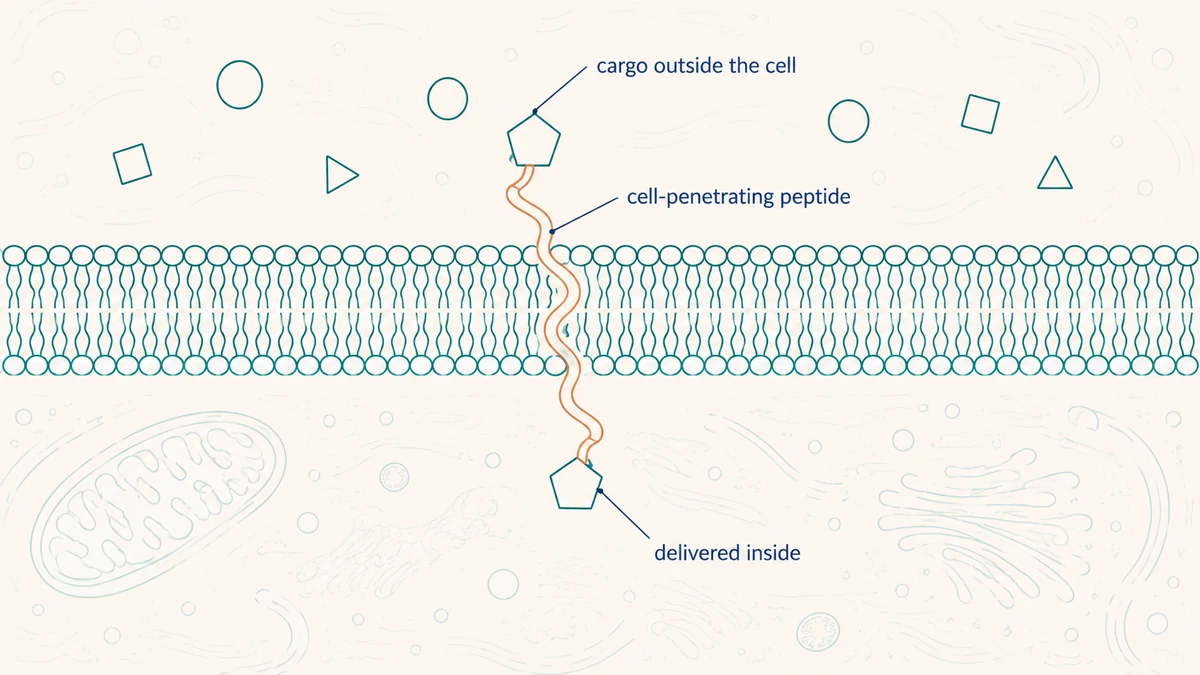
Cell-penetrating peptides (CPPs), often referred to as "shuttle peptides," are transforming the landscape of drug delivery by enabling attached molecules to successfully cross previously impenetrable biological cellular barriers. Their ability to transport a wide range of cargoes, from small drug molecules to large RNA, DNA, and nanoparticles, is paving the way for a completely new type of pharmacology.
The Evolution to Intracellular Organelle Targeting
Historically, targeted drug delivery focused on reaching specific tissues or pathogenic cells. Today, CPP technology is advancing to an even more granular level: targeting specific intracellular organelles.
By covalently conjugating CPPs to specific targeting sequences, scientists can now direct therapeutics straight to the endoplasmic reticulum, lysosomes, mitochondria, or nuclei. Leading researchers in the field note that this precise, organelle-targeted delivery provides several profound clinical benefits:
- Improved Efficacy: Drugs are delivered exactly where they are needed within the cell to exert their biological effect.
- Reduced Toxicity: By localizing the drug's impact, unwanted side effects on other parts of the cell or body are minimized.
- Overcoming Drug Resistance: Direct organelle targeting provides new pathways to bypass the mechanisms cells use to resist standard therapeutics.
CRISPR Integration and Non-Viral Gene Delivery
One of the most highly anticipated applications of CPPs is their integration with gene therapies and genomic editing tools like CRISPR.
As gene therapy advances, the industry has recognized that relying on traditional viral vectors for delivery carries significant safety and immunogenicity risks. Consequently, researchers are aggressively pursuing safe, non-viral methods of genetic delivery, and peptides are proving to be a highly effective solution.
Key advancements in this integration include:
Nuclear Localization Signal (NLS) Peptides: To get genetic material like DNA or CRISPR components to work, they must enter the cell's nucleus. Researchers have found that attaching an NLS peptide to DNA can actively direct the genetic payload straight to the nucleus. This peptide-conjugate approach is smaller and more streamlined than other methods, and has been shown to increase gene expression by up to 18-fold compared to controls.
Advanced Delivery Frameworks: Researchers are successfully developing advanced peptide-based vectors (such as PepFect6) for the efficient intracellular delivery of short interfering RNA (siRNA). Furthermore, CPPs are being combined with novel nanostructures, such as zeolitic imidazolate frameworks, to safely encapsulate and deliver genetic material into the cell.
Unlocking Nuclear Localization Signals (NLS)
Nuclear Localization Signal (NLS) peptides improve the delivery of genetic material, such as CRISPR components or DNA, into the nucleus by acting as targeted, non-viral delivery vehicles.
When attached to genetic material, NLS peptides provide several key advantages that enhance delivery:
Direct Nuclear Targeting: NLS peptides actively direct the attached DNA or gene therapy payload straight to the cell's nucleus, ensuring the material reaches the exact location where it is needed to be effective.
Smaller Size and Streamlined Entry: Compared to other delivery conjugates, such as nanobodies, NLS peptides are smaller in size and offer a much more streamlined mechanism for penetrating the nuclear barrier.
Increased Gene Expression: Because of this highly efficient and direct intracellular routing, NLS peptide conjugates have been shown to significantly boost efficacy, increasing gene expression by up to 18-fold compared to control methods.
Ultimately, by utilizing NLS peptides, researchers can overcome the significant safety risks and clinical fatalities historically associated with traditional viral vectors, providing a safer, highly effective non-viral method for advancing gene therapies.
Conclusion
By functioning as "programmable intracellular taxis," CPPs are unlocking the true potential of precision medicine, allowing researchers to safely deliver advanced gene therapies and targeted treatments directly into the specific cellular engines that drive disease.