Peptide Research Category Leaders
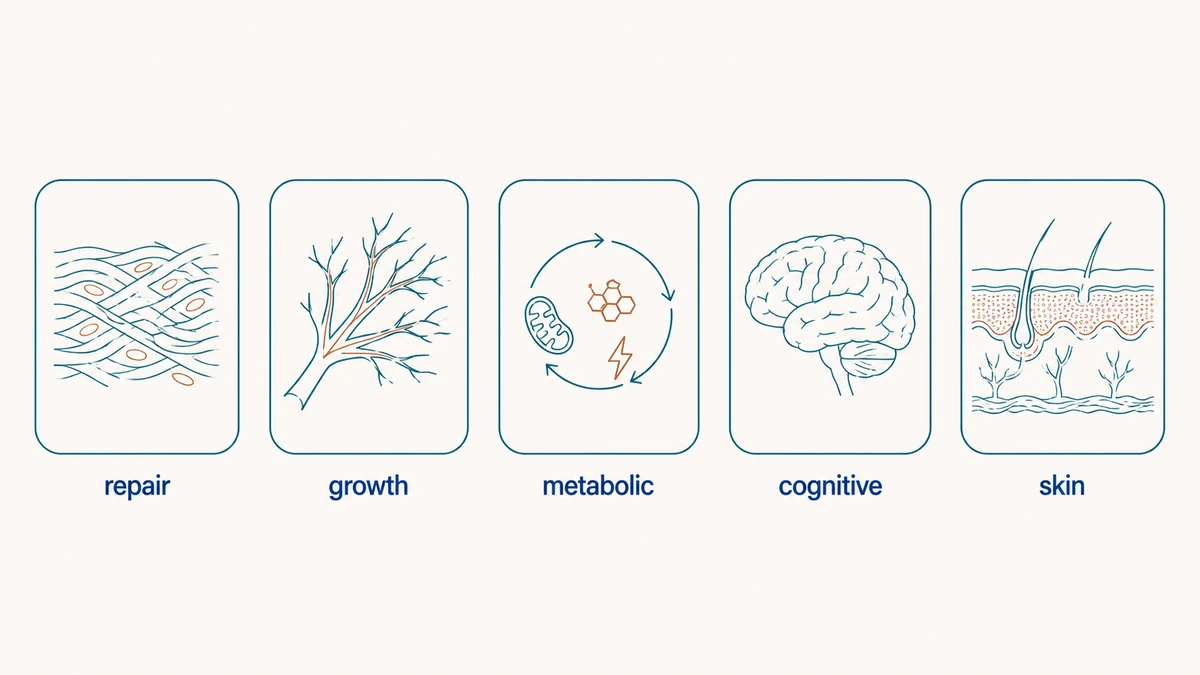
Researchers entering an unfamiliar peptide-research category often want a quick orientation on which compounds dominate the published literature in that field - not because one peptide is universally 'best', but because publication density determines how much methodological precedent and mechanistic detail exist for any given study design. This article surveys five major research categories - tissue-repair / regeneration, cognitive / neurotrophic, anti-aging / cellular senescence, growth-hormone-axis, and metabolic / GLP-1-axis - and identifies the compounds that dominate the published primary literature in each.
This is not a therapeutic guide and not a recommendation framework for human use. The framing throughout is research-mechanism leadership: which compound has the deepest peer-reviewed mechanistic record in its category, which secondary compounds occupy adjacent niches, and where the literature is still emerging. For each category, the article identifies a literature lead, one or two well-characterized secondary compounds, a specialized tool for narrower research questions, and (where relevant) emerging compounds with smaller but growing publication records. Internal links direct to the full mechanism reviews on this site and to the relevant Baltic BioLabs research peptide product pages. See our research disclaimer for full research-only framing.
Quick Reference Matrix
The matrix below summarizes the dominant research compounds in each of the five categories surveyed in this article. 'PP availability' indicates whether the compound is supplied by Baltic BioLabs as a research-grade peptide; pharmaceutical-only compounds are noted as 'pharmaceutical' rather than research-peptide. Each row is expanded in the sections that follow.
| Research category | Dominant compound(s) | Mechanism class | PP availability |
|---|---|---|---|
| Tissue-repair / regeneration | BPC-157, TB-500 | Multi-pathway angiogenic + actin sequestration | Research peptide |
| Cognitive / neurotrophic | Semax, Selank, Cerebrolysin | BDNF modulation, anxiolytic, neuropeptide cocktail | Research peptide / mixed |
| Anti-aging / cellular senescence | Epitalon, GHK-Cu, FOXO4-DRI | Telomerase induction, gene expression, senolytic | Research peptide / specialty |
| Growth-hormone-axis | CJC-1295 DAC, Ipamorelin, Sermorelin | GHRH analog + GHSR-1a agonist | Research peptide |
| Metabolic / GLP-1-axis | GLP-3, AOD-9604 | Triple incretin agonist, HGH 176-191 fragment | Research peptide |
The matrix reflects publication density and mechanistic centrality, not therapeutic ranking. Researchers selecting a study compound should treat this as a starting point for further reading, not as a substitute for direct primary-literature review.
Tissue-Repair / Regeneration Research Category
The tissue-repair literature is dominated by two compounds with non-overlapping mechanisms. BPC-157 is the literature lead by publication volume - the Sikiric group at the University of Zagreb has published a sustained corpus on the 15-amino-acid pentadecapeptide across gastrointestinal protection, tendon and ligament repair, hepatic ischemia-reperfusion, and emerging neurological injury models. The mechanistic backbone is non-canonical activation of the VEGFR2-Akt-eNOS axis (Hsieh 2017), upregulation of EGR-1 and engagement of the FAK-paxillin focal-adhesion pathway in tendon fibroblasts (Chang 2011, 2014), and bidirectional nitric oxide system rebalancing.
The well-characterized secondary compound is TB-500, a 17-amino-acid synthetic fragment of Thymosin Beta-4 (Tβ4) containing the conserved LKKTETQ alpha-helix. TB-500 acts through a single biochemically specific mechanism - 1:1 sequestration of monomeric (G-) actin - that complements rather than overlaps with BPC-157's signaling profile. Goldstein and colleagues established the parent Tβ4 biology, and Bock-Marquette et al. (2004, Nature) anchored the cardiac progenitor migration literature that distinguishes TB-500 from BPC-157 in cardiac and dermal repair contexts.
For specialized skin-specific tissue-remodeling research, GHK-Cu occupies a distinct niche characterized by Pickart and colleagues - a copper-binding tripeptide with documented effects on fibroblast biology and broad gene-expression modulation in dermal models. GHK-Cu's research domain is dermal remodeling and wound healing in skin specifically.
For a head-to-head comparison, see BPC-157 vs TB-500: Mechanisms & Research Compared.
Cognitive / Neurotrophic Research Category
The cognitive and neurotrophic peptide literature is anchored by a body of Russian neuropharmacology research that is less familiar to Western readers but highly developed within its own publication ecosystem. Semax is the literature lead - a synthetic heptapeptide derived from a fragment of adrenocorticotropic hormone (ACTH 4-7) extended with a Pro-Gly-Pro tripeptide tail. Semax has been investigated in cognitive and stroke-recovery models since the 1980s by the Russian Academy of Medical Sciences. The most consistently reported mechanism is modulation of brain-derived neurotrophic factor (BDNF) expression, with documented effects on hippocampal BDNF and TrkB signaling in rodent models. The compound is registered as a pharmaceutical in Russia for ischemic stroke indications, providing collateral safety data uncommon for research peptides.
The secondary compound is Selank, a synthetic heptapeptide analog of the immunomodulatory peptide tuftsin, investigated primarily for anxiolytic and cognitive-modulatory effects, with rodent-model literature documenting effects on serotonin and GABA signaling. Like Semax, it has a Russian pharmaceutical registration.
Cerebrolysin is a more specialized tool - a porcine-brain-derived hydrolysate containing a mixture of low-molecular-weight peptides rather than a single defined synthetic peptide. It has been investigated in stroke recovery, traumatic brain injury, and Alzheimer's-model contexts. Because Cerebrolysin is a peptide cocktail, the mechanistic literature is harder to parse than for Semax or Selank, but the clinical research record is substantial.
Emerging compounds - with smaller but growing research bases - include Dihexa (an angiotensin-IV-derived hexapeptide investigated for hippocampal effects) and Noopept (a proline-containing dipeptide investigated for cognitive endpoints in rodent models). The published volume on either is a fraction of Semax's.
Anti-Aging / Cellular Senescence Research Category
The anti-aging research category is unusually heterogeneous because it spans several distinct biological mechanisms - telomere biology, gene-expression modulation, senolytic targeting, and pineal neuropeptide signaling - that share an aging-related research framing but operate on different cellular machinery.
Epitalon is the literature lead - a synthetic tetrapeptide (Ala-Glu-Asp-Gly) developed by Vladimir Khavinson and colleagues at the St. Petersburg Institute of Bioregulation and Gerontology. The Khavinson group has published extensively on Epitalon's effects on telomerase induction, telomere elongation in cell-culture models, and circadian and pineal-axis regulation. The mechanistic centerpiece - telomerase upregulation in somatic cells - places Epitalon at the heart of the synthetic-peptide telomere literature, although independent Western replication is more limited than the Khavinson dataset alone.
The secondary compound is GHK-Cu, the same copper-binding tripeptide noted above, here in its anti-aging context. Pickart's 2012 review documented GHK-Cu effects on the expression of over 4,000 genes in cultured fibroblasts, including upregulation of stem-cell, matrix-remodeling, and antioxidant pathways. GHK-Cu's anti-aging footing is gene-expression modulation rather than telomerase induction.
The specialized tool is FOXO4-DRI, a designed-retro-inverso peptide investigated as a senolytic - a selective inducer of apoptosis in senescent cells. The keystone paper is Baar et al. (2017, Cell), reporting that FOXO4-DRI selectively kills senescent cells by disrupting the FOXO4-p53 interaction, with downstream improvements in fitness markers in aged mice.
Pinealon is an emerging tool - a related Khavinson-group tripeptide investigated for neuroprotective and cognitive effects with mechanistic overlap with Epitalon, with smaller publication volume.
Growth-Hormone-Axis Research Category
The growth-hormone-axis category is anchored by the Bowers GHRH+GHRP-synergy literature established in the 1990s and 2000s, which provides the mechanistic basis for the most-published research stack in this space.
The literature lead is the CJC-1295 + Ipamorelin combination - more precisely, the Mod GRF 1-29 + Ipamorelin stack for pulsatile-mimicking research, with CJC-1295 DAC alone occupying a separate sustained-elevation niche. CJC-1295 is a GHRH(1-29)NH₂ analog with four protease-resistant substitutions; the DAC variant carries a maleimidopropionic acid linker that covalently binds serum albumin to extend plasma half-life from ~30 minutes to ~6-8 days (Teichman et al. 2006). Ipamorelin is a selective GHSR-1a agonist (Raun et al. 1998) that activates the ghrelin receptor system on the same somatotrophs targeted by GHRH analogs, producing synergistic GH release when co-administered with a GHRH analog (Bowers 1991, 2004).
The secondary compound is Sermorelin - the synthetic 29-amino-acid N-terminal fragment of endogenous GHRH, with the shortest plasma half-life of the major GHRH analogs (~10-15 minutes). Sermorelin was approved by the FDA in 1990 (Geref) for pediatric GH deficiency before being discontinued for commercial reasons in 2008, providing historical clinical safety data that does not exist for CJC-1295.
For specialized pulsatile-mimicking studies, MOD GRF 1-29 is the no-DAC variant of CJC-1295. Its 30-minute plasma half-life preserves natural pulsatile GH release in research models, making it the GHRH-class partner of choice for stacking with Ipamorelin.
Emerging compounds include Hexarelin and GHRP-2/6 - older ghrelin-receptor agonists with substantial 1990s publication records but less selective receptor profiles than Ipamorelin (more cortisol and prolactin elevation at GH-active doses).
For the head-to-head comparison, see CJC-1295 vs Ipamorelin vs Sermorelin: GH Research.
Metabolic / GLP-1-Axis Research Category
The metabolic / GLP-1-axis category is framed strictly as research-only in this overview. The compounds that dominate the registered clinical literature - semaglutide, tirzepatide, and retatrutide - are pharmaceutical products developed through full Phase 3 programs and are not typically available as research peptides through ethical research-supply channels.
The research-grade lead is GLP-3, a triple-receptor agonist research analog supplied for in vitro and animal-model investigation of combined GLP-1 / GIP / glucagon receptor signaling. GLP-3 is the closest research-peptide analog to the clinical triple-agonist retatrutide (LY3437943) characterized by Coskun et al. (2022, Cell Metab) and Knerr et al. (2022, Mol Metab), suited to receptor-binding assays, cell-line signaling experiments, and rodent metabolic models. GLP-3 is a research peptide, not a substitute for any registered clinical product.
The specialized tool is AOD-9604, the synthetic HGH 176-191 C-terminal fragment investigated since the 1990s for fat-metabolism research independent of the somatogenic effects of full-length human growth hormone. The mechanistic framing is fat-metabolism research rather than incretin-axis research, and the compound is not interchangeable with GLP-3.
For the pharmacological history of the registered clinical compounds, see Tirzepatide vs Semaglutide vs Retatrutide: Research History. That article is a research-history reference - none of those compounds is supplied as a research peptide.
How to Choose for Your Research
The five categories surveyed above each have distinct research-question logic. The selection framework below summarizes how researchers typically match a research question to a compound based on the published literature, not on therapeutic positioning.
- If your research model studies tissue regeneration, tendon or ligament repair, or gastrointestinal cytoprotection, the literature on BPC-157 is the most developed. For models that additionally require cytoskeletal-migration components (cardiac progenitor, dermal, corneal), TB-500 is the appropriate complement.
- If your research question concerns BDNF modulation, hippocampal cognitive endpoints, or neurotrophic signaling in stroke or TBI models, Semax has the deepest published mechanistic literature of the cognitive peptides covered here, with Selank as a secondary anxiolytic-cognitive tool.
- If your research is on telomere biology, telomerase activity, or pineal-axis circadian regulation, Epitalon is the literature lead. For gene-expression-modulation research with broader transcriptomic endpoints, GHK-Cu is the better characterized tool. For senolytic-mechanism research specifically, FOXO4-DRI is mechanistically distinct.
- If your research model studies pulsatile GH release or GHRH+GHRP synergy, the Mod GRF 1-29 + Ipamorelin stack is the classic protocol. For sustained GH/IGF-1 elevation studies, CJC-1295 DAC alone is the appropriate tool.
- If your research investigates triple-receptor incretin agonism in vitro or in rodent metabolic models, GLP-3 is the research-grade analog supplied for that purpose. For fat-metabolism research with HGH-fragment mechanisms, AOD-9604 is the specialized tool.
This is a research-selection framework based on literature density and mechanistic specificity. Nothing in this section is a recommendation for human use of any compound; all remain strictly research-use-only.
Frequently Asked Questions
The questions below address common orientation issues researchers raise when first navigating the five-category landscape covered in this article. Each answer points to the relevant primary literature or to the deeper review article on this site.
Conclusion
The five research categories surveyed above each have distinct literature leaders defined by publication density and mechanistic centrality, not by therapeutic positioning. BPC-157 and TB-500 dominate tissue-repair research; Semax anchors the cognitive and neurotrophic literature; Epitalon and GHK-Cu lead the anti-aging mechanistic record; CJC-1295 and Ipamorelin are the most-published growth-hormone-axis stack; and GLP-3 is the research-grade analog for triple-incretin-agonism investigation in models that cannot use the registered pharmaceutical compounds.
This article is an overview of that landscape, not a substitute for direct primary-literature review. All compounds discussed remain research-use-only. See our research disclaimer, the Baltic BioLabs research peptide product range, and the deeper individual category reviews linked throughout for full context.
Source this peptide for your research
Order BPC-157 at Baltic PeptidesResearch source
Source BPC-157 for your research
Lab-tested, ≥99% HPLC purity. Certificate of Analysis available per batch.
View productFrequently Asked Questions
How do I decide between two compounds within the same research category?
Match the specific research question to the mechanism that compound is best characterized for, not to the broader category label. Within tissue-repair, for example, BPC-157 has the deepest gastrointestinal and tendon-fibroblast literature while TB-500 has the strongest cardiac and dermal record. Within the GH-axis category, CJC-1295 DAC produces sustained elevation while CJC-1295 no-DAC plus Ipamorelin produces pulsatile mimicking. The 'best' compound is the one whose published mechanistic record most closely matches the research question, not the one with the highest absolute publication count.
Are these compounds interchangeable in research models?
No. Even within a single category, compounds typically have distinct mechanisms - BPC-157 acts on growth-factor receptor signaling and TB-500 acts on cytoskeletal actin; Epitalon induces telomerase and GHK-Cu modulates gene expression; CJC-1295 binds GHRHR and Ipamorelin binds GHSR-1a. Substituting one compound for another within a category will generally produce different downstream effects in any model that distinguishes the underlying receptor or pathway. Use the compound whose mechanism matches the research question.
Which research category has the most peer-reviewed literature?
By raw publication volume, the metabolic / GLP-1-axis category is by far the largest - but most of that volume sits with the registered pharmaceutical compounds (semaglutide, tirzepatide, retatrutide), not with research-grade peptides. Among research-grade synthetic peptides, the tissue-repair category - anchored by BPC-157 and TB-500 - and the growth-hormone-axis category - anchored by the CJC-1295 + Ipamorelin literature plus the older Sermorelin clinical record - have the deepest research-peptide publication bases.
What's the difference between research-grade and pharmaceutical peptides?
Research-grade peptides are supplied for in vitro and animal-model investigation, with batch-level Certificate of Analysis documentation including HPLC purity (typically ≥99%) and mass-spectrometry identity confirmation, but without the regulatory dossier required for human therapeutic use. Pharmaceutical peptides have completed an FDA or EMA approval pathway including formal Phase 1-3 trials, GMP manufacturing certification, and a registered indication. Research peptides are not pharmaceutical products and are not intended for human use.
Where can I see published research on each compound?
Each category section above links to the deeper review article on this site, which in turn lists primary references with PubMed identifiers. PubMed (pubmed.ncbi.nlm.nih.gov) is the standard search index for the underlying primary literature, and Google Scholar provides broader coverage including non-English sources for compounds with substantial Russian-language research bases (notably Semax, Selank, Epitalon, and Pinealon). Batch-level analytical data for the research peptides referenced above is published in the Baltic BioLabs lab reports archive.
Is this article a recommendation for using these compounds?
No. This article is a literature-density overview of which compounds dominate the published research record in each of five categories. It is not a recommendation for human use, not a therapeutic guide, and not a clinical-decision framework. All compounds discussed remain research-use-only outside the specific registered pharmaceutical exceptions noted in context. See our research disclaimer for full framing.
Scientific References
- Sikiric P, Skrtic A, Gojkovic S, et al. Stable gastric pentadecapeptide BPC 157 as a therapy: from gastric ulcer to multi-organ injury. Curr Med Chem. 2022;29(11):1845-1872
- Chang CH, Tsai WC, Lin MS, et al. The promoting effect of pentadecapeptide BPC 157 on tendon healing involves tendon outgrowth, cell survival, and cell migration. J Appl Physiol. 2011;110(3):774-780. PMID: 21030672[PubMed Reference]
- Goldstein AL, Hannappel E, Kleinman HK. Thymosin beta4: actin-sequestering protein moonlights to repair injured tissues. Trends Mol Med. 2005;11(9):421-429. PMID: 16099219[PubMed Reference]
- Bock-Marquette I, Saxena A, White MD, et al. Thymosin beta4 activates integrin-linked kinase and promotes cardiac cell migration, survival and cardiac repair. Nature. 2004;432(7016):466-472. PMID: 15565145[PubMed Reference]
- Pickart L, Vasquez-Soltero JM, Margolina A. GHK peptide as a natural modulator of multiple cellular pathways in skin regeneration. Biomed Res Int. 2015;2015:648108. PMID: 26236730[PubMed Reference]
- Khavinson VK, Bondarev IE, Butyugov AA. Epithalon peptide induces telomerase activity and telomere elongation in human somatic cells. Bull Exp Biol Med. 2003;135(6):590-592. PMID: 12937682[PubMed Reference]
- Baar MP, Brandt RMC, Putavet DA, et al. Targeted apoptosis of senescent cells restores tissue homeostasis in response to chemotoxicity and aging. Cell. 2017;169(1):132-147.e16. PMID: 28340339[PubMed Reference]
- Bowers CY. Growth hormone-releasing peptide (GHRP). Cell Mol Life Sci. 1998;54(12):1316-1329. PMID: 9893708[PubMed Reference]
- Teichman SL, Neale A, Lawrence B, Gagnon C, Castaigne JP, Frohman LA. Prolonged stimulation of growth hormone (GH) and insulin-like growth factor I secretion by CJC-1295, a long-acting analog of GH-releasing hormone, in healthy adults. J Clin Endocrinol Metab. 2006;91(3):799-805. PMID: 16352683[PubMed Reference]
- Raun K, Hansen BS, Johansen NL, et al. Ipamorelin, the first selective growth hormone secretagogue. Eur J Endocrinol. 1998;139(5):552-561. PMID: 9849822[PubMed Reference]
- Holst JJ. The physiology of glucagon-like peptide 1. Physiol Rev. 2007;87(4):1409-1439. PMID: 17928588[PubMed Reference]
- Coskun T, Urva S, Roell WC, et al. LY3437943, a novel triple glucagon, GIP, and GLP-1 receptor agonist for glycemic control and weight loss: from discovery to clinical proof of concept. Cell Metab. 2022;34(9):1234-1247. PMID: 35985340[PubMed Reference]
Related Research Peptides
BPC-157
Retatrutide